Blender, open source software
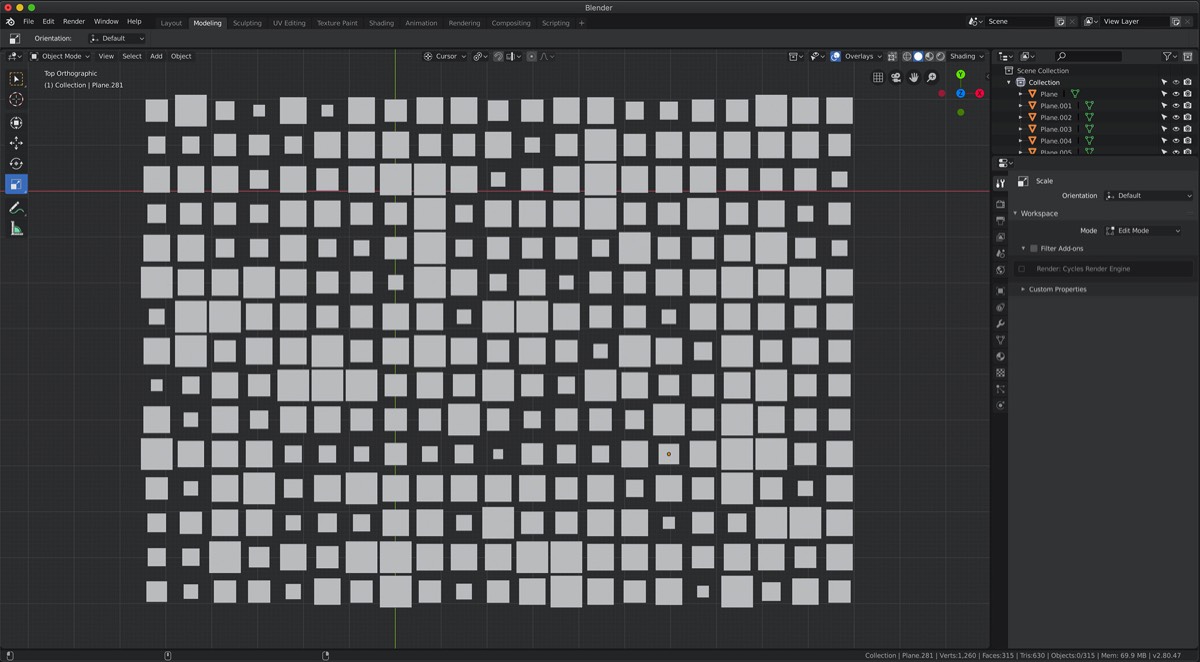
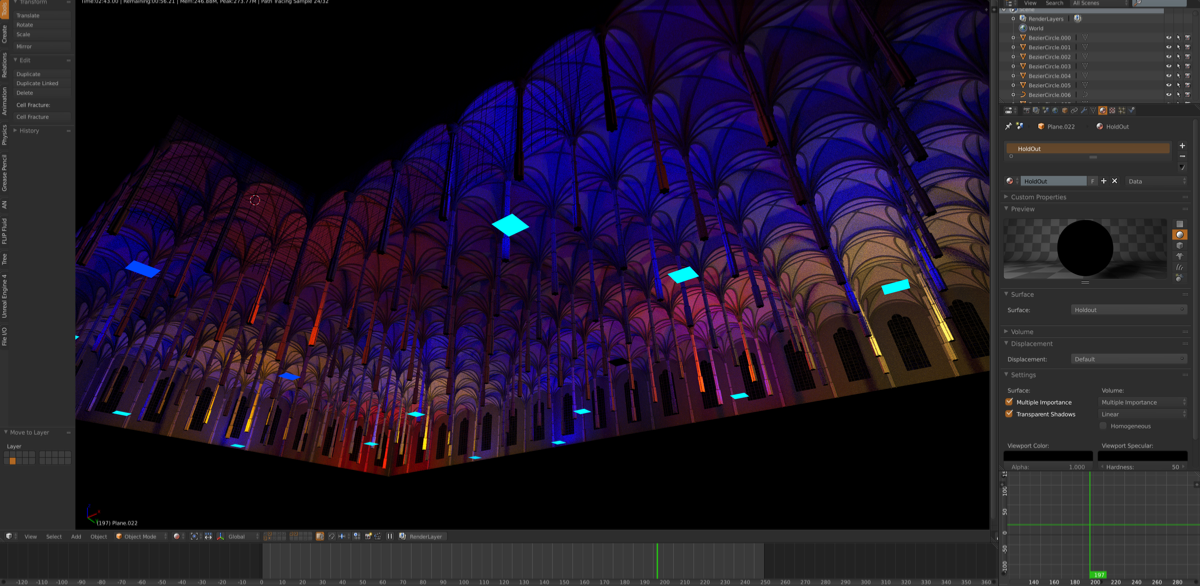
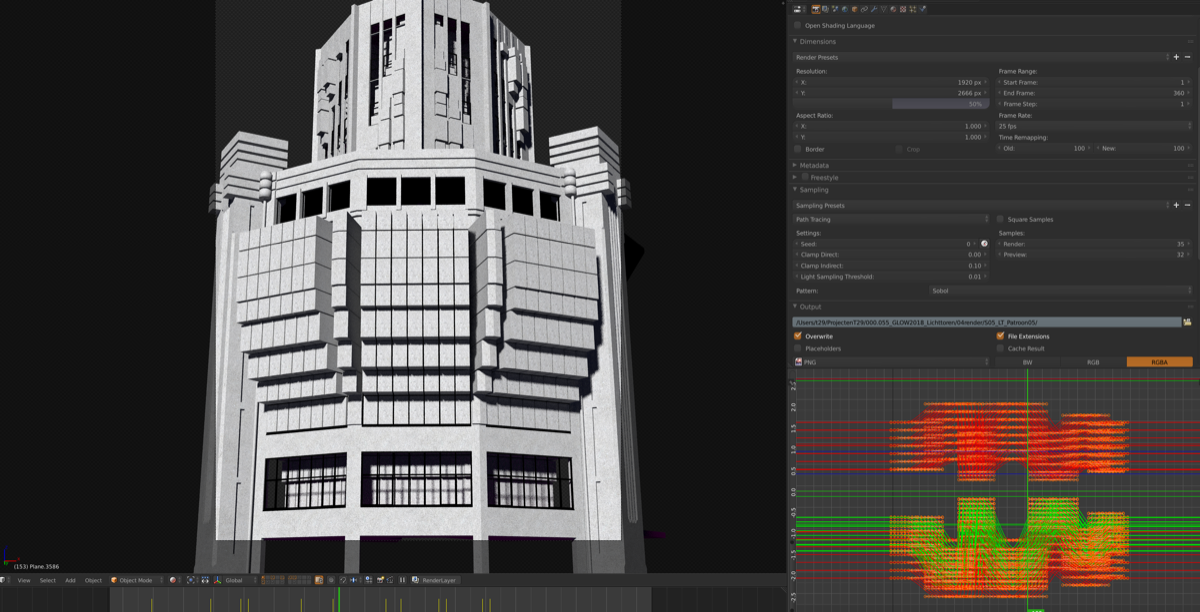
TrackTo uses blender as its basic 3D software, a package we have been familiar with from the very outset. Blender is open-source software. The great thing about Blender is that it is used and supported worldwide. The software is therefore enthusiastically maintained and utilised on all sides. Blender is of Dutch origin; it was developed by an early animation studio based in Eindhoven, NeoGeo, which was managed by Ton Roosendaal. Blender has become a truly indispensable package in today’s highly mature world of animation. Even big boys, such as Pixar, use Blender to create models for the many cinema films they produce. In the animation and 3D mapping world, Blender is an indispensable tool.
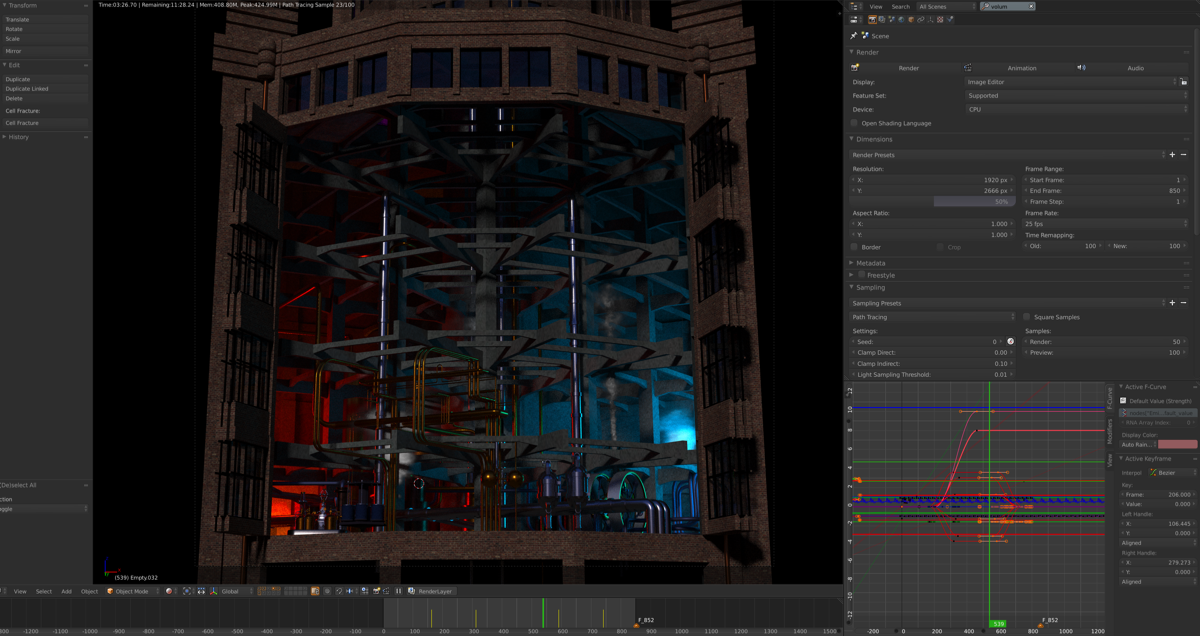
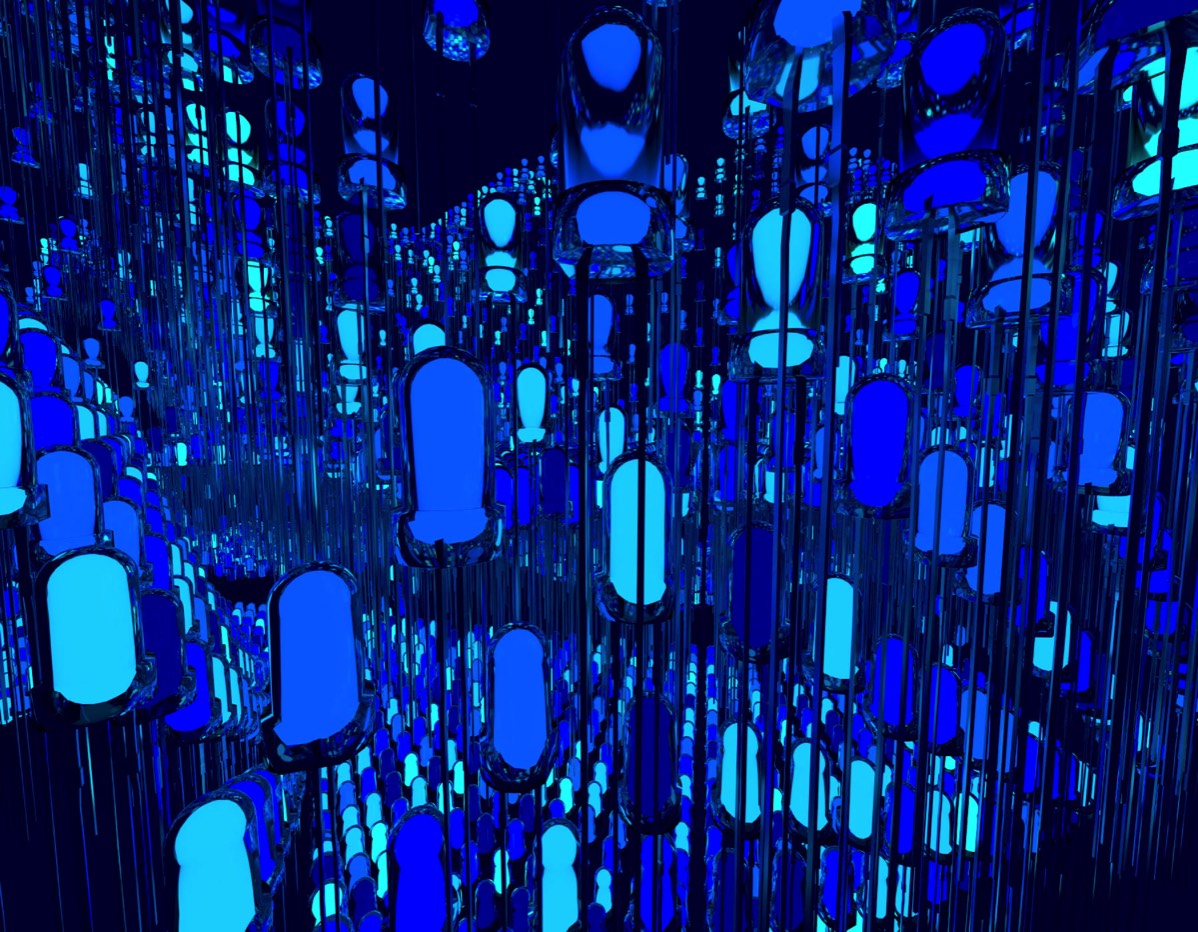
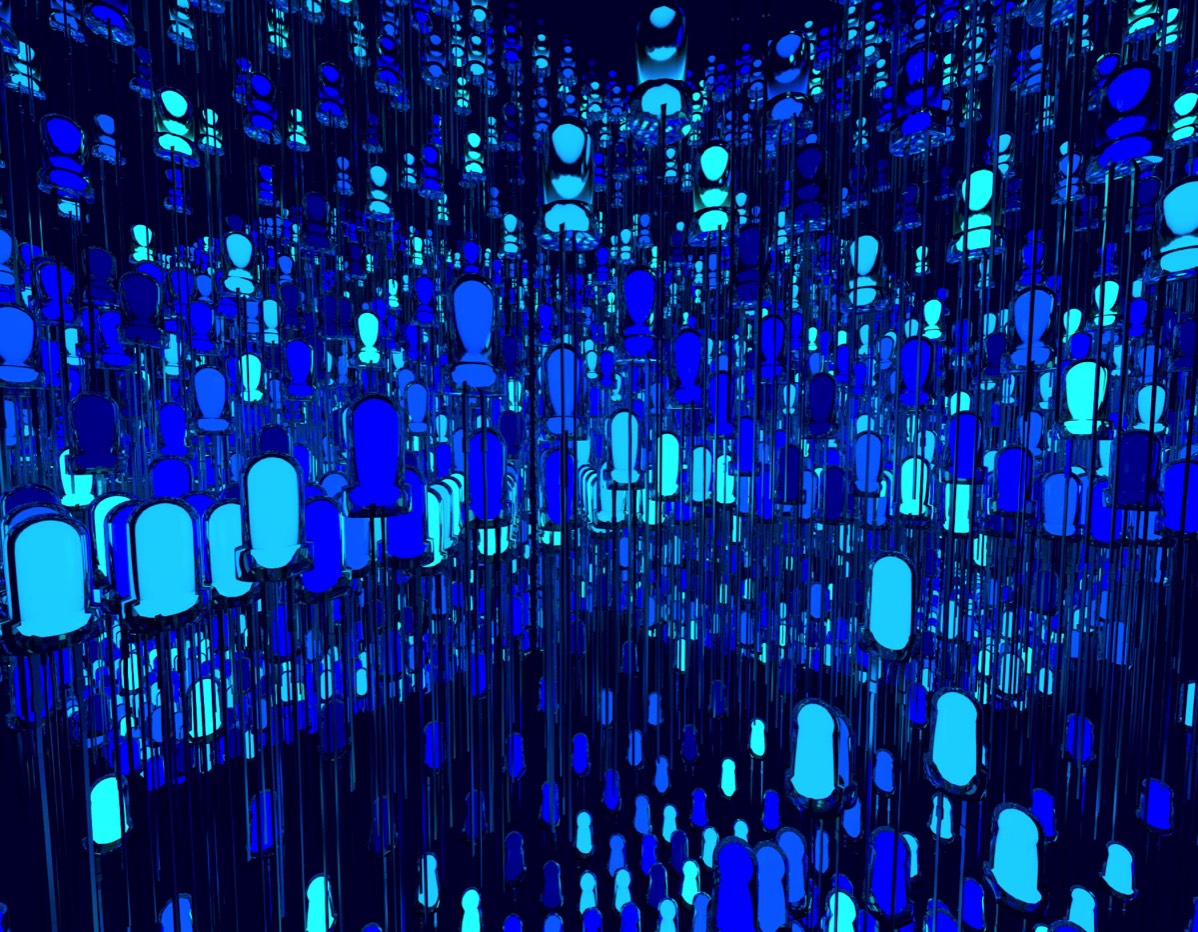
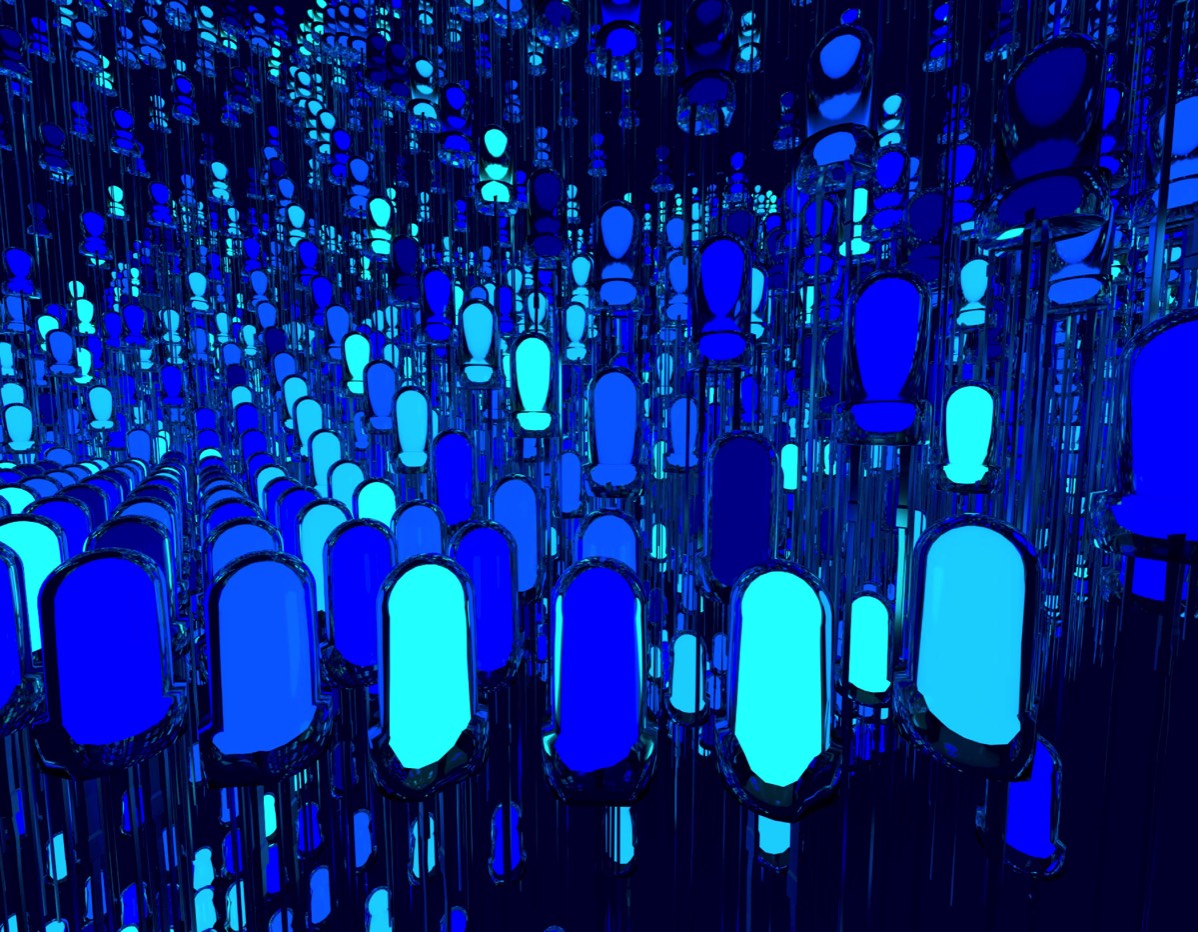
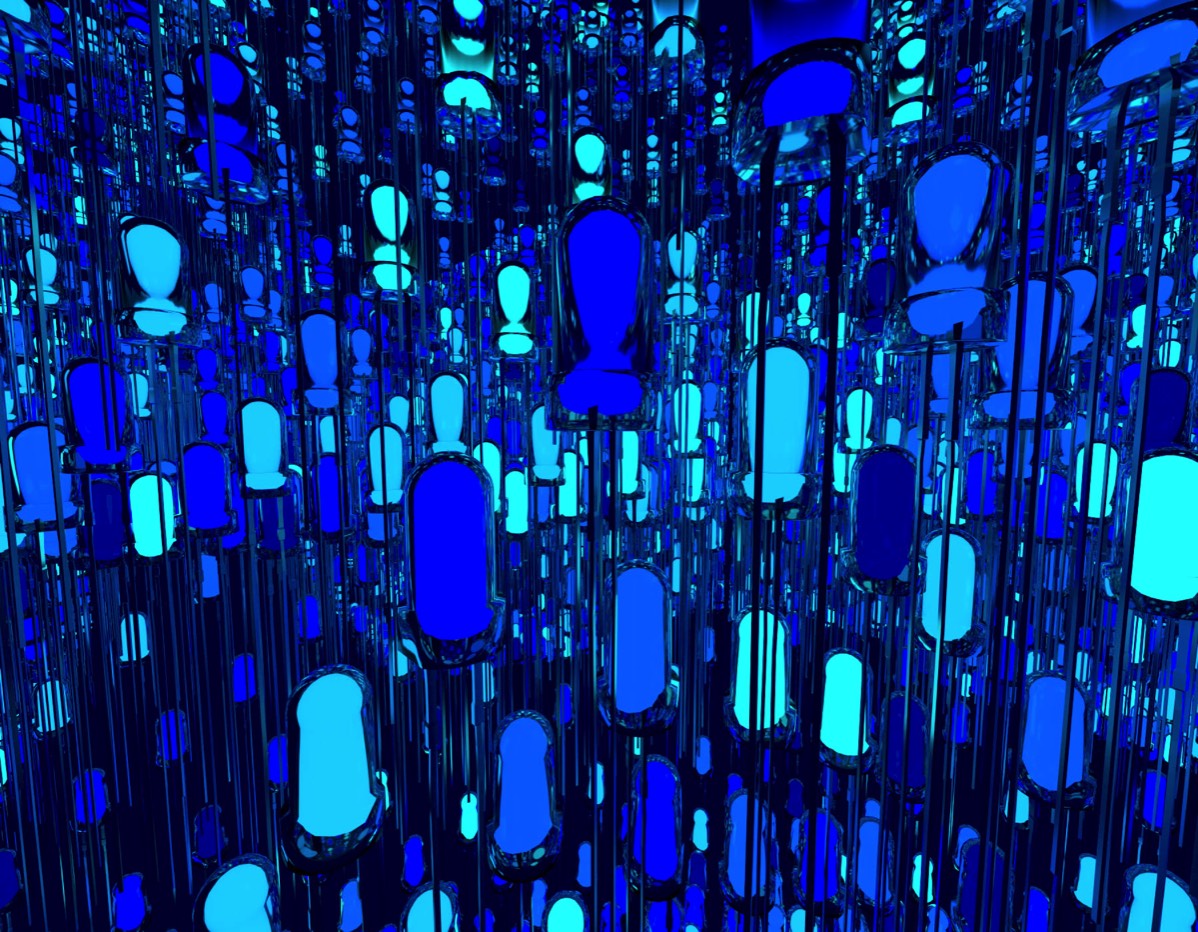
3D scene in Blender from the show Colour Symphony
The possibilities that Blender offers
Blender offers infinite possibilities, including the following:
• Various modelling capabilities, such as: polygon meshes, NURBS, metaballs, and vector fonts.
• Reading and writing various 3D file formats, such as those from Wings 3D, 3D Studio, LightWave, obj, fbx, stl and many others.
• Creating animations, with: inverse kinematics, skeletal and lattice deformations, keyframes, non-linear animation, constraints, vertex weighting and static or dynamic particles that take objects into account.
• Creating games; while this is very basic, it can be extended with Python.
• An integrated, non-linear video editor. This editor enables one to mix video clips with sound and add effects. The Camera Tracking feature, which mimics the movement of the real camera with the Blender Camera using an algorithm, also enables one to conveniently mix 3D content with real footage.
These digital additions are also known as VFX (Visual Effects).
Numerous such features were added, extensively tested and improved during the “Mango Open Movie Project”, where people used only Blender and other open source software to create and add special effects to a short film. (Source Wikipedia)
• Various modelling capabilities, such as: polygon meshes, NURBS, metaballs, and vector fonts.
• Reading and writing various 3D file formats, such as those from Wings 3D, 3D Studio, LightWave, obj, fbx, stl and many others.
• Creating animations, with: inverse kinematics, skeletal and lattice deformations, keyframes, non-linear animation, constraints, vertex weighting and static or dynamic particles that take objects into account.
• Creating games; while this is very basic, it can be extended with Python.
• An integrated, non-linear video editor. This editor enables one to mix video clips with sound and add effects. The Camera Tracking feature, which mimics the movement of the real camera with the Blender Camera using an algorithm, also enables one to conveniently mix 3D content with real footage.
These digital additions are also known as VFX (Visual Effects).
Numerous such features were added, extensively tested and improved during the “Mango Open Movie Project”, where people used only Blender and other open source software to create and add special effects to a short film. (Source Wikipedia)
3d scene in Blender, animation video-transition
3D scene in Blender from the show Tower of Light
Immeasurable space
The use of 3D software enables one to work in an immeasurable space. Whether the topic is the universe or molecules, everything can be created and scaled in the Blender working environment. We can therefore not only create traditional animations, but also set up virtual reality applications. Every job starts with an empty space, an empty theatre. We then proceed to provide the set, the actors, the lighting and the orchestra each time, in order to create another spectacular show. As no two jobs are ever the same, however, each naturally calls for a completely unique approach and insight. In the meantime, we have acquired over twenty years of experience in supervising and producing 3D animations and mappings, and the use of Blender particular.
Animation in Blender, IPO curve screen
The beauty of IPOs
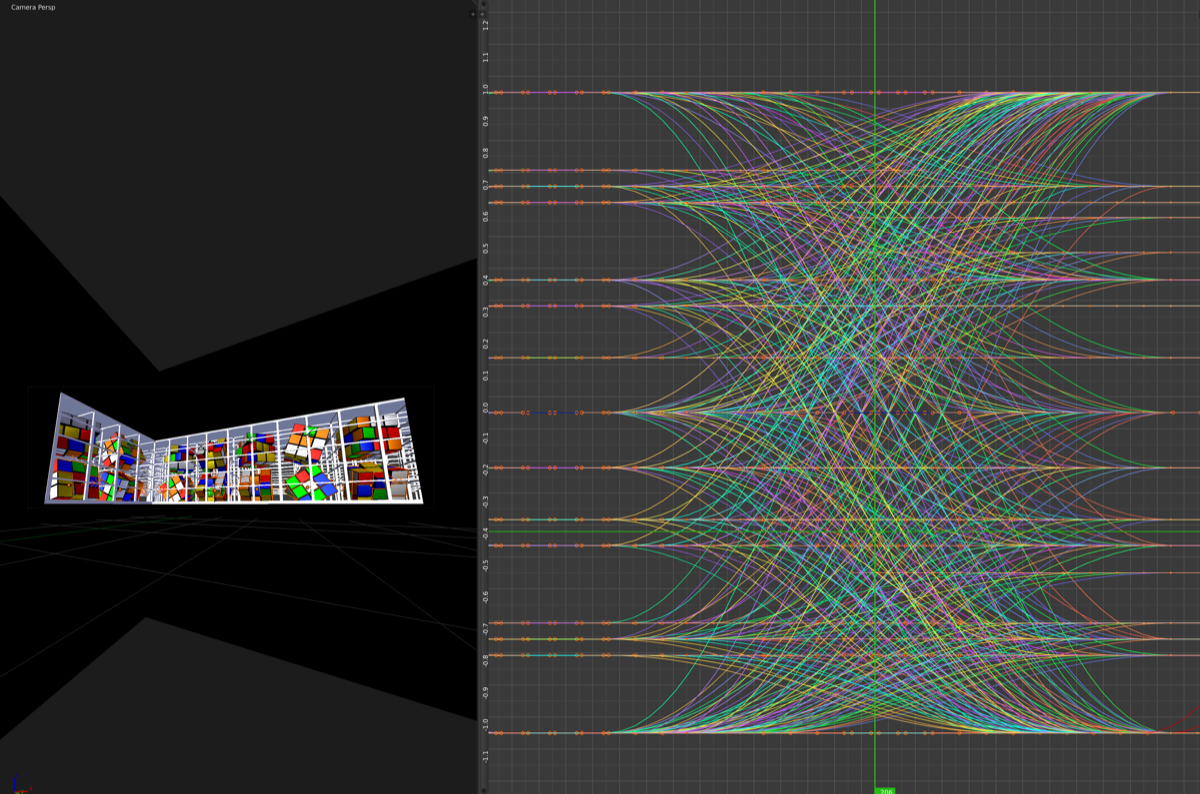
Making animations basically consists of moving objects from point A to point B. To fix the movements of objects, you need a system that plots the object’s coordinates, position, rotation, size, stance, etc. on a timeline. Such markers are known as keyframes. Keyframes therefore enable you to control anything that needs to be moved. The software interpolates all the intermediate steps between points A and B set using keyframes. You can therefore set things up for the object to make a smooth, rapid or rectilinear movement. This keyframe data can be “read” in the IPO curves, mathematical lines that graphically present the movement and behaviour of the object. These IPOs can be conveniently adjusted. Such adjustments include the position, rotation, size and duration of movement. Not only objects can be controlled this way, but also light, the sun, skies, physical elements like wind, water or turbulence.
3D scene in Blender from the show Colour Symphony
3D scene in Blender from the show Tower of Light
3D scene in Blender from the show Stay Tuned
Tower of Light, GLOW Eindhoven 2018
Colour Symphony, GLOW Eindhoven 2019
Tower of Light, GLOW Eindhoven 2018
Blob the Bulb, GLOW Eindhoven 2017
Detail from Colour Symphony, GLOW Eindhoven 2019
Detail from STAY TUNED, GLOW Eindhoven 2022
STAY TUNED on the square, GLOW Eindhoven 2022
Reality and illusion
TrackTo is a specialist in 3D mapping. Thanks to our years of experience in making 3D animations, we can transform reality into a marvellous show. We surprise viewers by bringing buildings to life, as we did in the “Philips Licht Toren” project executed in Eindhoven. A splendid spectacle as a means of sharing a virtual experience together. “Shared Immersive Experience” A good production relies very much on a strong concept and the accompaniment of a tailored soundtrack.
Blob The Bulb, GLOW Eindhoven 2017
The originality of one’s own imagery
The originality of the work is paramount. The fact that TrackTo uses 3D software enables us to retain complete control. This affords us the opportunity to make optimum use of content/ visualisation/motion design for our 3D mapping projects. We are therefore not restricted by the need to purchase stock images, such as VJ loops. The fact that we build all our own content offers us the added advantage of total control over our project, content and performance and the royalty-free use of all material. This enables establish on a project-by-project basis the compatibility of content and the building, with a view to merging the two in an original spectacle. Stock images are often rather mundane and jittery. We prefer to instil a sense of tranquillity by creating an original product, allowing the show ultimately presented to both surprise and convince the audience.
The size of the building (project) also often determines the speed of the content, as this helps retain both the sense of reality and the intensity of the connection between the audience and object. A convincing dynamic, the interplay between the actual building and the digital images, the logic and physics are all key factors in optimising the original experience our projects offer.
Colour Symphony, GLOW Eindhoven 2019
STAY TUNED, GLOW Eindhoven 2022
SHAPE, GLOW Eindhoven 2023
Testing in VR
Clausplein Eindhoven “Witte Dame” in preperation
When creating a 3D mapping project, one needs to achieve a match between the actual building and the virtual image. These two elements have to fit together seamlessly. To organise the content properly, one has to be entirely familiar with the appearance of the facade on which it is to be projected. We therefore reproduce it in a highly accurate 3D model of the building, which enables us to turn the site into a virtual environment. This can be used to gain control of the accuracy of all the settings at a very early stage. Such a VR application enables us to optimally test the perspective of the building and the show. It is the model that serves as the basis for building the content, and therefore the entire story.
Virtual testing environment Clausplein
No opportunity to test
It is not particularly difficult to test and correct a 3D animation. After all, it is a linear sequence that one can easily play repeatedly. Correcting 3D mapping projects, on the other hand, is virtually impossible. The two main stumbling blocks are;
1 the hardware setup (beamers, containers, audio, power supply, etc.) is not constructed until shortly before the launch of the event, due to security and cost considerations in particular. It is therefore simply not possible to test the show on site a month in advance.
2 the ultimate high-resolution rendering of the completed film to be projected by the beamers. These “films” are almost invariably produced in ultra-high resolution, well in excess of 4K. The substantial projection dimensions of 3D mapping projects inevitably imply that the image comprises vast numbers of pixels. On-site testing is therefore hardly possible, as rendering – which can take several weeks – is not carried out in-house but at so-called render farms. Were I to render it all myself, over a year of computer utilisation would be required for each project. Re-rendering errors in the space of two days is simply not an option therefore.
1 the hardware setup (beamers, containers, audio, power supply, etc.) is not constructed until shortly before the launch of the event, due to security and cost considerations in particular. It is therefore simply not possible to test the show on site a month in advance.
2 the ultimate high-resolution rendering of the completed film to be projected by the beamers. These “films” are almost invariably produced in ultra-high resolution, well in excess of 4K. The substantial projection dimensions of 3D mapping projects inevitably imply that the image comprises vast numbers of pixels. On-site testing is therefore hardly possible, as rendering – which can take several weeks – is not carried out in-house but at so-called render farms. Were I to render it all myself, over a year of computer utilisation would be required for each project. Re-rendering errors in the space of two days is simply not an option therefore.
Virtual testing environment Clausplein with virtual public
Life registration “Colour Symphony” show on the Clausplein, GLOW 2019